

An exhibition exploring the enduring and multi-faceted relationship between the Cayman Islands and the sea opens this week.
‘The Sea is History’, which runs at the Cayman Islands National Museum from Thursday, 16 October, reflects on the ocean as both a living archive and a defining presence in Caymanian life.
It will feature a variety of historical and contemporary artefacts, all with some kind of connection to the sea and the Cayman Islands and all from the museum’s own collection.
The title of the exhibition is taken from the poem ‘The Sea is History’, by St Lucian poet and playwright Derek Walcott.
The first stanza of the poem reads: “Where are your monuments, your battles, martyrs? Where is your tribal memory? Sirs, in that grey vault. The sea. The sea has locked them up. The sea is History.”
Veerle Poupeye, the museum’s director, told Cayman Independent: “Walcott invokes the sea as a collective memory site, as a living archive of those diasporic experiences that shaped the modern Caribbean.
“Omnipresent, the sea also shapes the way of life in the Caribbean archipelago.”
With its rich maritime history, and a tourism sector reliant on the sea, this idea is particularly relevant in the Cayman Islands, she said.
“Here, the sea has been a source of isolation and connection, with nearby and far-flung places, and a silent witness to momentous historical events and personal stories as well,” Veerle said.
“As Caymanians know well, the sea gives and it takes; it is a source of sustenance and salvation, but it can also be violent and destructive.
“Many Caymanians have lost their lives at sea and major hurricanes have wreaked devastation on the islands, yet the sea has also enabled the success of trade and industries, such as thatch and turtle, seafaring, and, more recently, tourism.”
She explained that humans, in turn, can affect the sea with their over-consumption causing global warming and overfishing, putting the marine environment and what it supports at threat.
All this is explored in the exhibition.
Veerle said: “This exhibition provides a poetic take on the foundational relationship between the Cayman Islands and the sea, as a repository of stories and memories that delve deeply into the Caymanian cultural identity.
“It features historical and more recent artefacts, some of them mysterious and others well-documented, that were retrieved from the sea or found washed up on the islands’ beaches, along with other objects and images that originated on the islands and speak to the sea as a defining presence in Caymanian life and history.”
An opening reception that is open to all will be held on 16 October from 6pm to 8pm.
Exhibition samples
Here, Veerle pulls out five highlights from ‘The Sea is History’ exhibition and tells us a bit about their background.
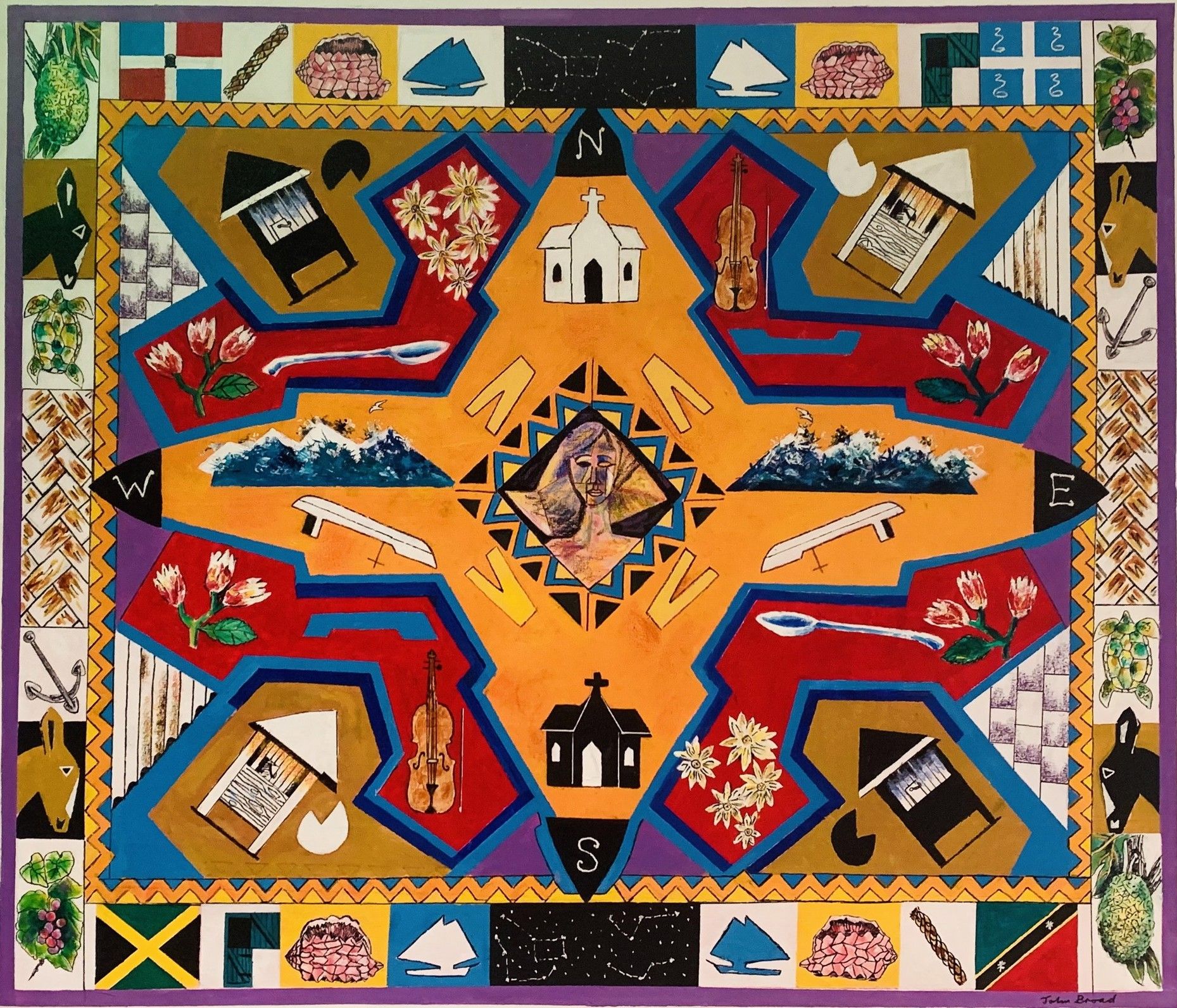
John Broad – Resilience Banner (2020), acrylic on canvas
In a painting that is laid out like a game-board, John Broad pays tribute to the resilience of the women who were left to manage daily life in the Cayman Islands, while the men were at sea.
The female figure at the centre of the composition is surrounded by symbols relating to the home and church, local cottage industries such as thatch-making, kitchen band music, and references to maritime life, such as the conch, the catboat, the bulk cargo ship, the compass points, and stormy seas.
It alludes to what provided the families at home with sustenance and support, but also to the hazards and uncertainties involved, making clever symbolic use of the game board allusions.
Broad recently donated the painting to the museum.
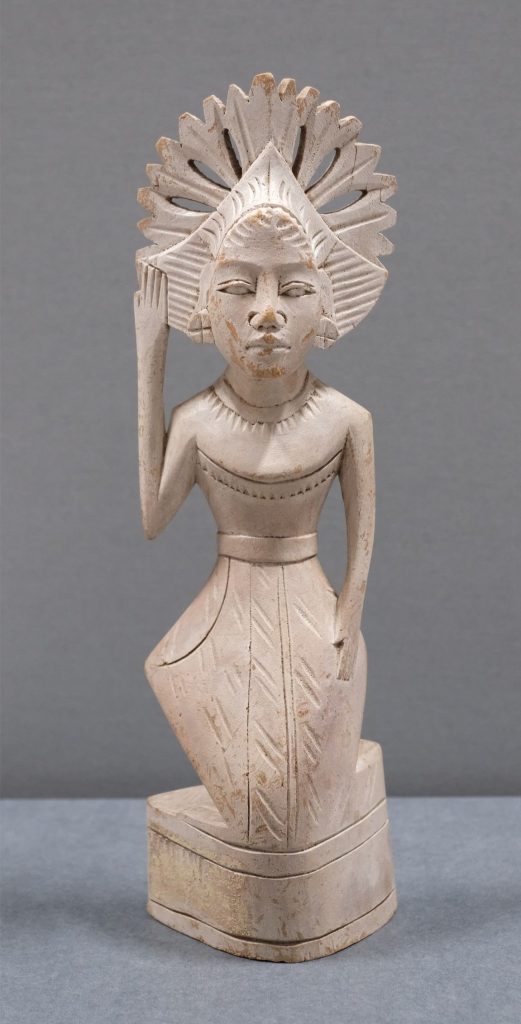
‘The Goddess Bali’ (1960s), woodcarving, Ira Thompson Collection
This sculpture was found by Ira Thompson in South Sound, likely on the beach, in 1964.
It may be representation of the Balinese goddess Dewi Danu, the water goddess of Balinese Hindus.
It has also been suggested that its origins may be closer to home, and that the figure may represent the Cuban Santeria goddess Yemaya, who is also associated with the sea and often takes the form of a mermaid.
The private collection of Ira Thompson was acquired by the Government of the Cayman Islands in 1979, and became the foundational collection of the Cayman Islands National Museum
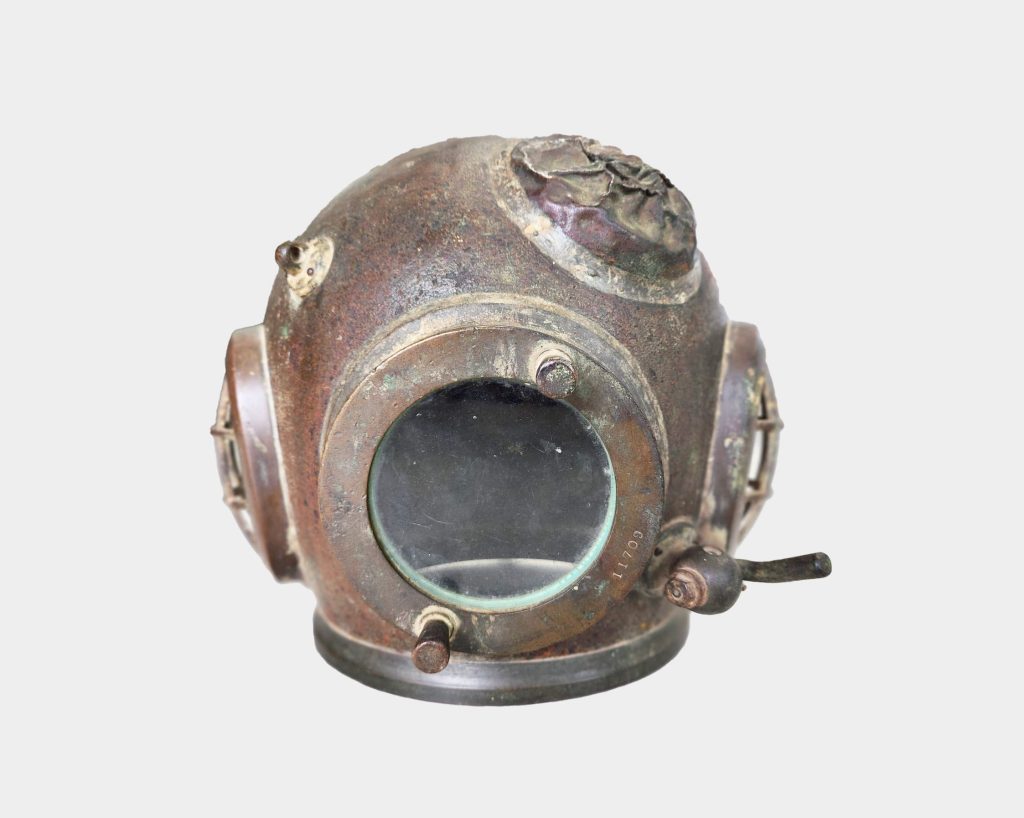
Diving Helmet (20th Century), metal and glass
This vintage diving helmet was found sometime in the 1970s or 80s on a local beach by a Caymanian fisherman, who sold it to its previous owner for $25 dollars and six Heineken beers.
It was on view at a local beach bar for many years and recently donated to the Museum by Julian Bostock.
It is not known by whom or for what specific purpose it was previously used.
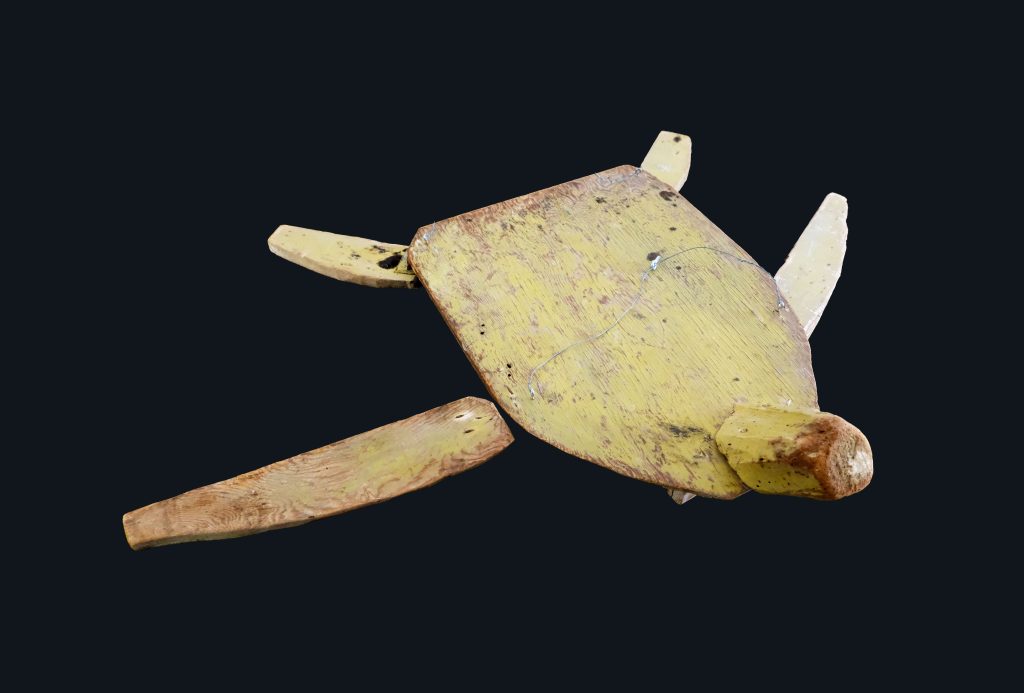
Turtle Decoy (20th century), wood and leather
This wooden turtle decoy is believed to have come from Mariculture Ltd, the first incarnation of what is now the Turtle Centre.
Such decoys were used to attract turtles during turtle fishing.
This artefact was recently donated to the museum by Berna and Steve Cummins. It speaks to the defining role of turtle fishery and cultivation in the history of the Cayman Islands.
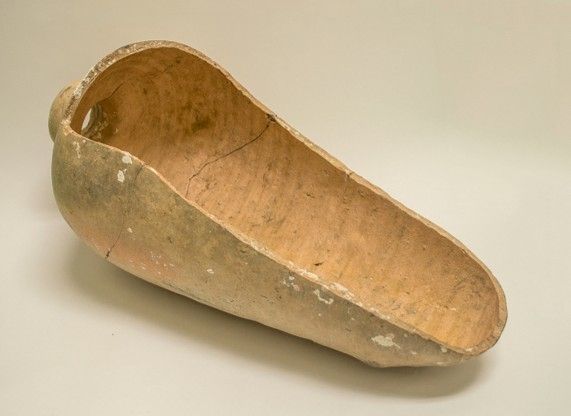
Olive Jar (17th century), earthenware
This earthenware jar is one of the oldest artefacts in the museum’s collection, found at the Turtle Wreck site in Little Cayman during an underwater archaeological survey in 1979-80.
The wreck consists of the remnants of a 60 feet long sailing ship along with several objects, of which this partially preserved jar is one.
It is believed that the ship, which was probably a turtling sloop, may have been wrecked during a 1669 attack by the Portuguese privateer Manuel Ribeiro Pardal on turtle fishermen from
Port Royal who had established a small settlement in Little Cayman. This attack was in retaliation for Henry Morgan’s attacks on Spanish settlements in the region.
It speaks to the intense rivalries between the European colonial powers during this period of conquest and settlement in the Caribbean.
More information about the museum can be found on its website.