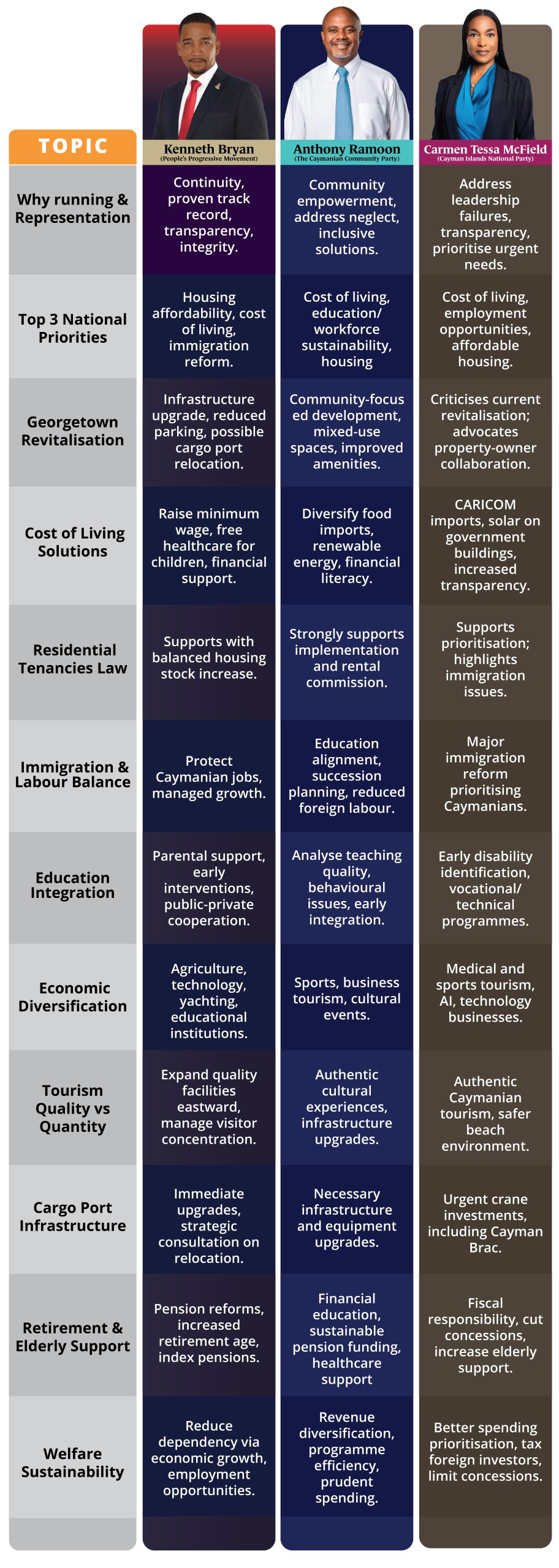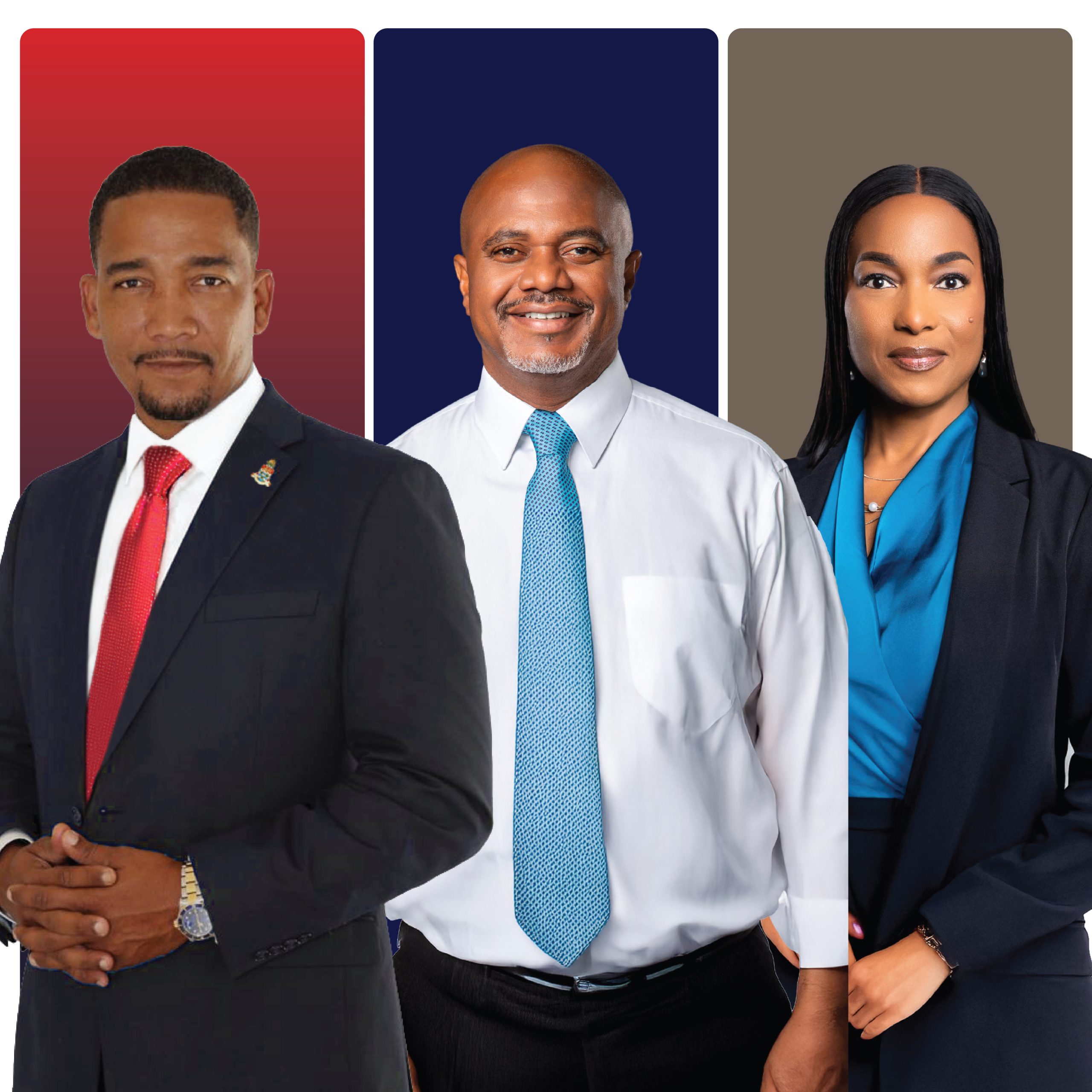
George Town Central candidates Kenneth Bryan, Anthony Ramoon, and Carmen McField debated critical issues such as cost of living, immigration policy, and George Town revitalisation at the Chamber of Commerce forum on Thursday, 3 April, clearly outlining their differing policy approaches.
Incumbent Kenneth Bryan of the People’s Progressive Movement (PPM) highlighted his experience, calling for voters to support continuity and ongoing projects. Bryan emphasised immigration reform focused on balancing growth with protecting Caymanian job opportunities, stating, “We got to make sure we’re asking the right question… It’s about protecting Caymanians and their opportunities in their homeland.” He proposed measures such as raising the minimum wage, alleviating the cost of healthcare for children, and increasing pensions withdrawls for retired persons to address the cost of living.
Anthony Ramoon of the Caymanian Community Party (TCCP) sharply criticised previous leadership, claiming George Town Central had been neglected and community development had been overlooked. Ramoon placed emphasis on affordable housing and cost-of-living reductions through diversified imports and renewable energy solutions. “Our constituency has been badly neglected. Our national tourism product and the quality of life has been eroded,” Ramoon said. He specifically suggested enhanced education and workforce training, aligning local skills with employment needs.
Carmen McField, representing the Cayman Islands National Party (CINP), stood out by strongly criticising government spending and transparency, describing a culture of unfulfilled promises. McField pushed for substantial immigration reform, prioritising Caymanian job placements, and addressing population-driven housing pressures. “Our immigration issue is a major problem. It stems to every little issue, such as housing, everything else,” she stated. McField suggested sourcing goods through CARICOM to lower living costs and recommended government-wide adoption of renewable energy.
Candidates broadly agreed on the need for George Town revitalisation but differed significantly on strategies. Bryan favoured infrastructure upgrades, adjusting parking regulations, and relocating cargo facilities to revitalise George Town’s waterfront, saying, “I’m not satisfied with the redevelopment of George Town Central, mainly because the lack of infrastructure, particularly with sewage, is one of the biggest hurdles.” Ramoon emphasised a community-centred approach, advocating mixed-use developments, heritage preservation, and improved public amenities, adding, “When you walk through town, there is basically not much open space… no benches, no shade, no public restroom.” McField criticised past revitalisation efforts as inadequately planned, calling instead for better coordination and collaboration with property owners, stating, “There’s buildings there that’s older than me… They need plumbing, electrical, so if you’re going to revitalise, have that conversation.”
On education, all candidates agreed that the public education system needed improvement but differed on solutions. Bryan focused on parental support and early childhood interventions to enhance educational outcomes, noting, “It takes a lot of work to be a parent and sometimes the cost factors for Caymanians put so much strain… the parent can’t do the number one job they were obligated to do, which is to be a good parent.”
Ramoon recommended comprehensive assessments of teaching quality and integrated school environments, remarking, “We have to look at it very closely under a microscope to say, what is it that the private school is doing differently from the public school?” McField stressed the early identification of learning disabilities and expanding vocational education opportunities, emphasising, “Our system has failed a lot of our children… Not all of our children are meant to be doctors, lawyers, and accountants.”
Economic diversification saw notable differences in emphasis. Bryan proposed expanding agriculture, marine industries, technology, and education sectors, arguing, “We’re surrounded by water. I don’t know why we don’t just grow lobsters and conch and shrimp.” Ramoon supported increased sports tourism, business tourism, and cultural events as key economic drivers, stating, “At one time sports was the pinnacle; now it’s something for us to revisit.” McField recommended developing medical tourism and technology-driven enterprises, highlighting, “We could advance or bring other things to our economy such as sports tourism, medical tourism… we could also do more tech-savvy things.”
Regarding elderly care, the candidates shared some common ground. Bryan called for pension system reforms and indexing pension payments to inflation. Ramoon emphasised financial literacy education and improved healthcare access, while McField uniquely proposed cutting developer concessions to increase funding for elderly support.
On welfare spending sustainability, Bryan argued for reducing dependency through economic growth and enhanced employment opportunities. Ramoon suggested diversifying government revenue streams and evaluating the effectiveness of welfare programmes. McField advocated better prioritisation of government spending and imposing taxes on large-scale foreign investors rather than offering concessions.
As the debate concluded, each candidate presented their distinct vision: Bryan promoted continuity and experience; Ramoon called for community-oriented changes; McField emphasised accountability and action. Bryan urged voters to continue with proven leadership; Ramoon invited residents to “get on the right track… the Ramoon train for change”; and McField called for a vote “to build a stronger, fairer, and more prosperous George Town Central.”