


Artificial intelligence (AI) has moved firmly into the mainstream in the Cayman Islands, with 72% of residents reporting they have used AI tools in the past 12 months, according to the 2026 Tower Consumer Survey.
The annual study, conducted by Tower Marketing between November 2025 and January 2026, interviewed 502 Cayman residents by telephone using a random digit selection process covering all districts. The margin of error is 4.4% at a 95% confidence level.
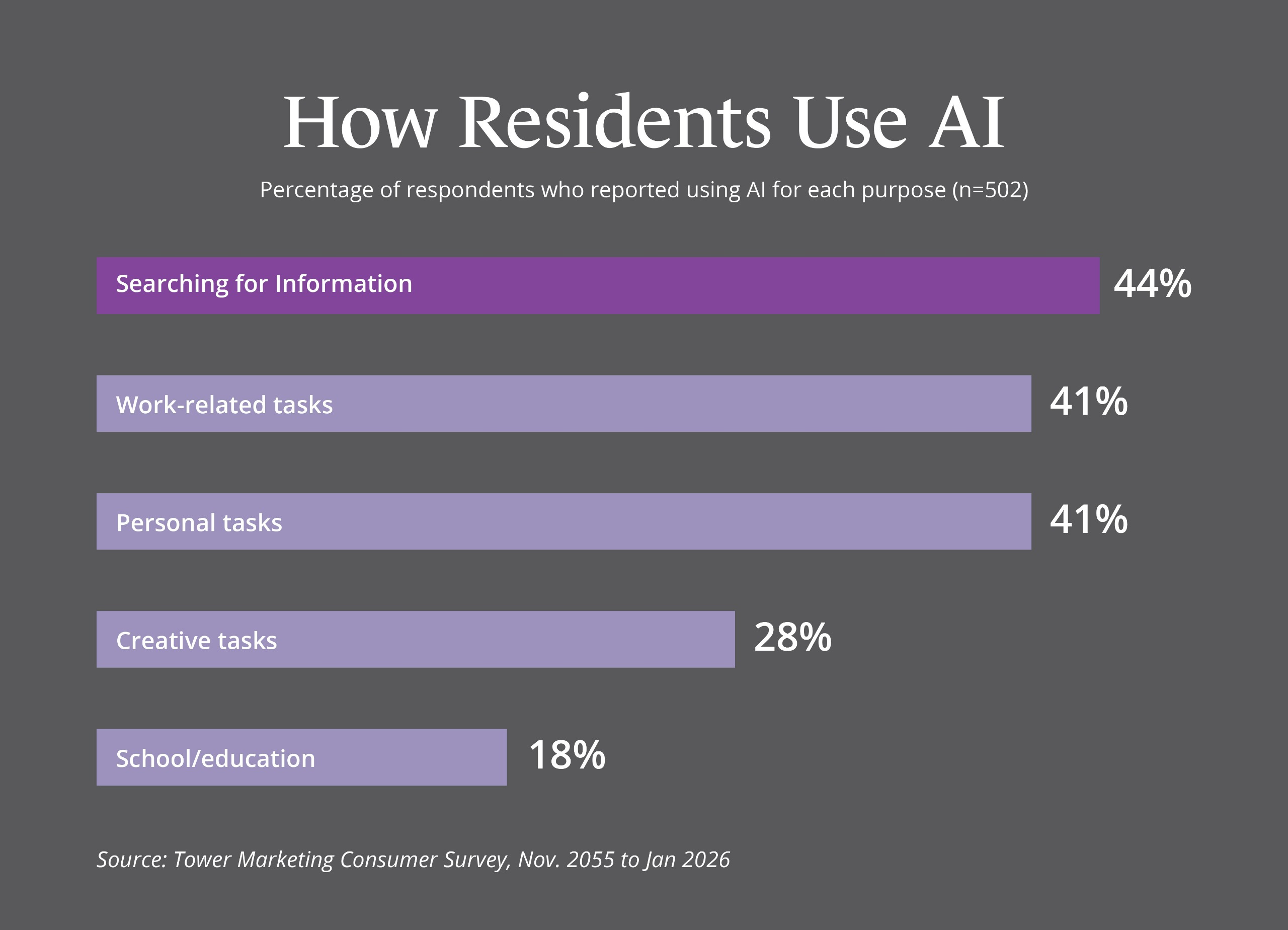
Searching for information was the most common use of AI at 44%, followed by work-related tasks and personal tasks, both at 41%. Creative tasks accounted for 28% and education for 18%. The results position AI primarily as a productivity and efficiency tool rather than a novelty, with its strongest foothold as an enhanced search engine and workplace assistant.
Among those aged 18 to 34, nearly half (49%) reported using AI for school or education, almost three times the rate of any other age group.
Work-related use was highest among the 35 to 54 bracket at 47%, suggesting AI is becoming embedded in professional routines across the islands’ dominant working-age population.
Attitudes were overwhelmingly favourable. Half of all respondents described their outlook on AI as positive, combining those who said they were very positive (23%) and somewhat positive (27%). A further 26% were neutral, while 20% said they were unsure. Only 5% expressed a negative view.
The survey revealed notable differences along lines of education and nationality. Among university graduates, 86% had used AI in some form, compared to just 53% of those with vocational or technical qualifications.
Caymanians demonstrated the highest engagement, with 91% reporting some form of AI use. Among Jamaican respondents, 26% had not used AI at all, and among Filipino respondents, the figure was 27%.
The sizeable group of residents who are either neutral (26%) or unsure (20%) about AI suggests that while resistance is minimal, understanding remains uneven.
The survey notes that AI is often used implicitly through features such as search algorithms and recommendations without users recognising it as artificial intelligence.
For the Cayman Islands’ financial services sector and broader business community, the findings point to a workforce that is already adopting AI tools at scale, though gaps in awareness and confidence suggest that structured guidance and training could help accelerate productive use across all segments of the population.
The Tower Consumer Survey has been conducted regularly since 2006.
