


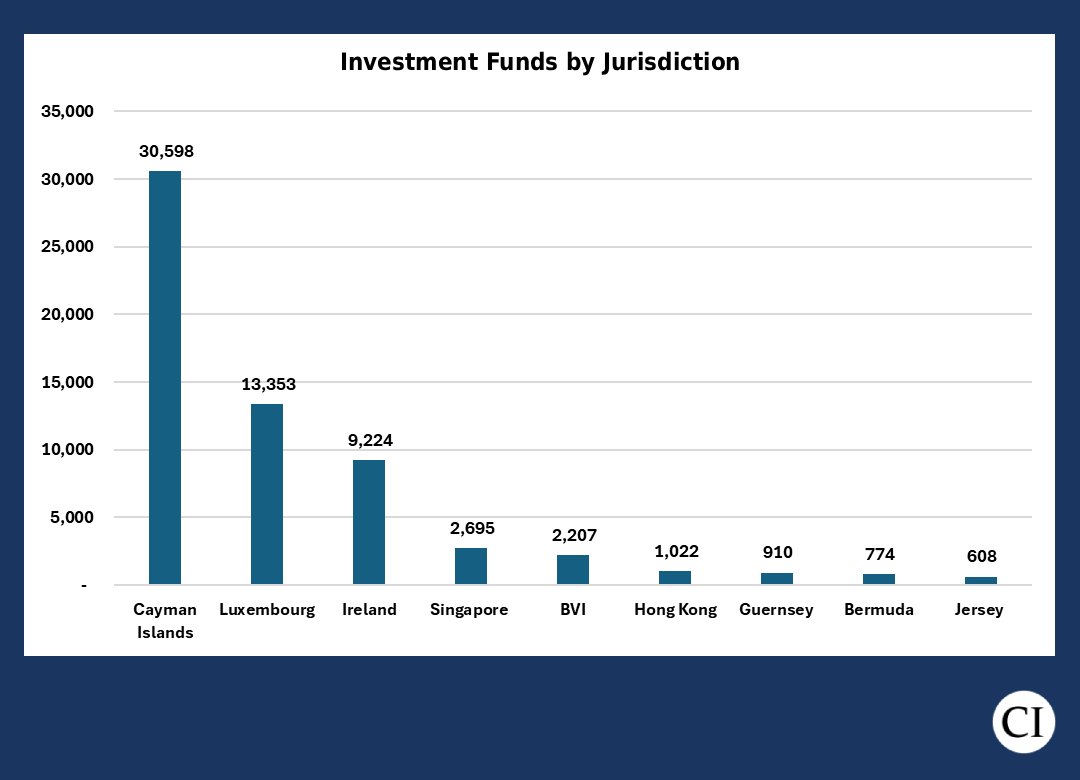
The number of private funds registered in the Cayman Islands has increased by 40% since 2020, according to newly released data from the Cayman Islands Monetary Authority (CIMA).
CIMA’s 2025 Fund Statistics show that 17,722 private funds were domiciled in the jurisdiction at the end of 2025, up from 12,695 at the end of 2020.
The increase follows the introduction of the Private Funds Act, which brought mandatory registration, audit requirements and formal regulatory oversight for valuation and custody arrangements.
In a Cayman Finance press release, Samantha Widmer, director and head of funds and capital markets at the not-for-profit organisation, said the 40% increase reflects Cayman’s ability to adapt to changing market conditions.
“The latest figures reinforce what we’re seeing across the market,” she said.
“Since the introduction of the Private Funds Act, Cayman has strengthened institutional confidence through consistent oversight, while still delivering speed to market through streamlined processes and a deep bench of experienced service providers.”
In the release, Cayman Finance said the islands’ fund sector has expanded rapidly in recent years, in step with growing demand for private credit fund-raising.
As banks reduced their exposure to middle-market lending in the years following the 2008 financial crisis, private credit managers increasingly stepped in to provide alternative financing, driving demand for private fund structures, it noted.

Private equity continues to play a central role in Cayman’s funds ecosystem, though fund structures have evolved, the organisation said.
Continuation vehicles and hybrid strategies – combining primary commitments, secondary transactions and co-investment rights – have become more prevalent as managers seek greater flexibility in managing assets over longer time horizons.
Across all fund types, Cayman remains the largest offshore jurisdiction by scale, according to Cayman Finance.
Cayman Islands regulatory expert Paul Byles who recently started acting as an independent funds director, has carried out several studies on the local financial services industry. “The funds sector is one of the largest drivers of the overall financial services industry’s growth over the past 2 decades” said Byles. He explained that legal, accounting, fund admin and support services have grown largely due to the success of Cayman as an investment funds domicile.
Cayman Finance noted that at the end of 2025, the islands were home to 30,598 funds, including 12,876 mutual funds. Hedge funds are generally registered as mutual funds under Cayman’s regulatory framework.
Cayman-domiciled funds managed about US$16 trillion in total assets at the end of 2024, with a net asset value of $9.1 trillion, it said.
Data from the US Securities and Exchange Commission shows that the jurisdiction accounts for roughly 32% of US private fund net assets.
International demand for Cayman fund structures remains strong, it said. Japanese institutional investors hold more than US$645 billion in overseas allocations, with an estimated 80% invested through Cayman-domiciled funds.
Funds managed from the United Arab Emirates recorded particularly strong growth, with net asset value rising by 200% year-on-year from 2023 to 2024, increasing from $26 billion to $78 billion.
Cayman funds managed from Brazil and Singapore also posted notable gains in net asset value, Cayman Finance noted.
While new private fund registrations eased slightly in the final quarter of 2025, this reflected broader global fundraising conditions and the timing of year-end fund de-registrations, it said.
The slowdown was partly offset by renewed interest in hedge fund strategies.
The global hedge fund industry expanded by about $628 billion in 2025, taking total assets beyond $5 trillion, according to Hedge Fund Research.
Widmer said that as private credit, continuation vehicles and hedge fund strategies continue to evolve, “Cayman’s flexibility and global credibility position it to support the next phase of investment growth”.
She added: “Virtual asset strategies and tokenised funds present new structural opportunities, with Cayman already hosting approximately 58% of crypto and digital asset hedge funds globally.”
