


The Cayman Islands’ financial system remained resilient in 2025 despite a more complex global risk environment, according to the Cayman Islands Monetary Authority (CIMA).
The authority made the conclusion in its Financial Stability Report 2024-2025 which assessed the jurisdiction’s financial system and the risks facing it.
CIMA said the system was supported by a strong domestic economy, prudential oversight and well-capitalised financial institutions, and it found no evidence of broad-based financial imbalances in the domestic economy.
The report identified interconnectedness as the most significant structural source of financial stability risk.
Cayman’s extensive cross-border financial links and the growing importance of market-based finance leave the financial system exposed to developments in global markets, the report said.
CIMA also identified climate-related risks and cyber and artificial intelligence-related operational risks as areas of increasing importance.
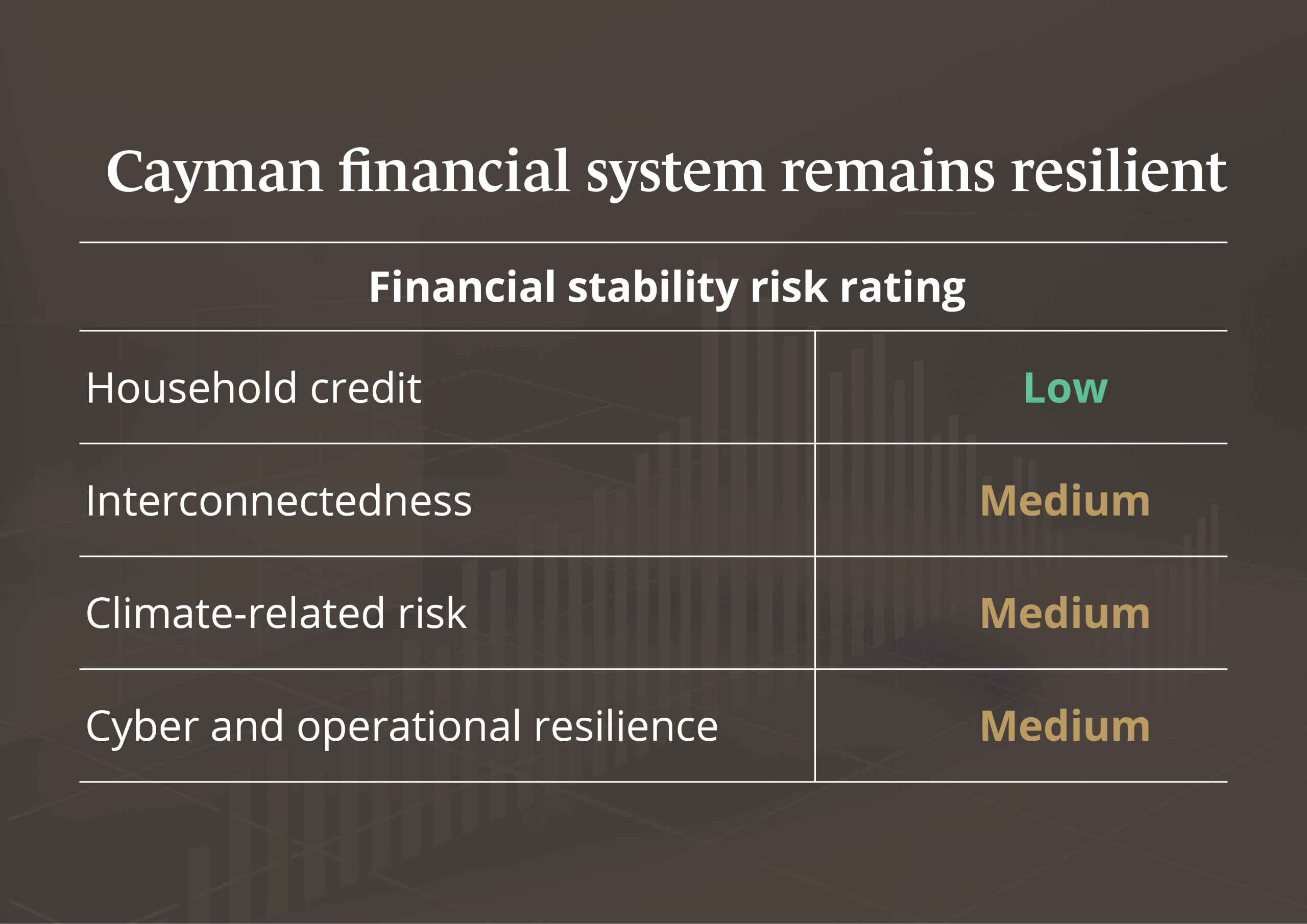
Household credit exposure was rated a low financial stability risk. Interconnectedness, climate-related risk and cyber and operational resilience risk were each rated medium.
Household leverage remained contained but CIMA said growth in non-mortgage borrowing, mortgage lending and property prices would require continued monitoring.
Cross-border financial exposures remained a key vulnerability despite a decline in their overall size, the report added.
Total external assets fell from about US$503 billion in 2021 to $325bn in 2025 while liabilities declined by a similar amount.
CIMA said the reduction was largely driven by lower banking sector positions. The authority said Cayman remained sensitive to global interest rates, liquidity conditions and investor sentiment.
Climate risk was assessed as medium with CIMA highlighting Cayman’s exposure to hurricanes, storm surge, extreme rainfall and sea-level rise.
The authority said these risks can affect financial stability through property damage, business interruption, collateral impairment, insurance affordability and operational disruption.
Cybersecurity and AI-related operational dependencies were also rated medium in the report.
CIMA said reliance on shared digital infrastructure, cloud services, third-party providers and AI-enabled systems could allow a disruption at one provider to affect multiple financial institutions.
According to the report, the investment funds sector remained a central component of Cayman’s financial system in 2025.
More than 30,000 regulated investment funds were domiciled in Cayman as of 31 December 2025 including 12,876 mutual funds and 17,722 private funds.
Cayman’s real GDP growth moderated to an estimated 2.6% in 2025 from 3.1% in 2024. Inflation fell to 1.3% while unemployment rose modestly to 2.8%.
In the report’s foreword, CIMA chief executive officer Cindy Scotland said the global macro-financial environment has become increasingly complex.
She described it as shaped by tighter financial conditions, geopolitical uncertainty, market volatility, technological change, climate risks and growing non-bank financial intermediation.
“For the Cayman Islands, these developments are particularly important given the jurisdiction’s role as a highly connected international financial centre,” she said.
“Despite this challenging external environment, the Cayman Islands financial system remained resilient.”
CIMA cited projections for 2.2% GDP growth and 5.3% inflation in 2026.
The authority’s priorities for 2026 and beyond include strengthening macroprudential surveillance and monitoring cross-border interconnectedness and non-bank financial intermediation.
Other priorities include improving climate-risk assessment and stress testing and reinforcing cyber and operational resilience. CIMA also plans to expand the data available to support financial stability monitoring.
